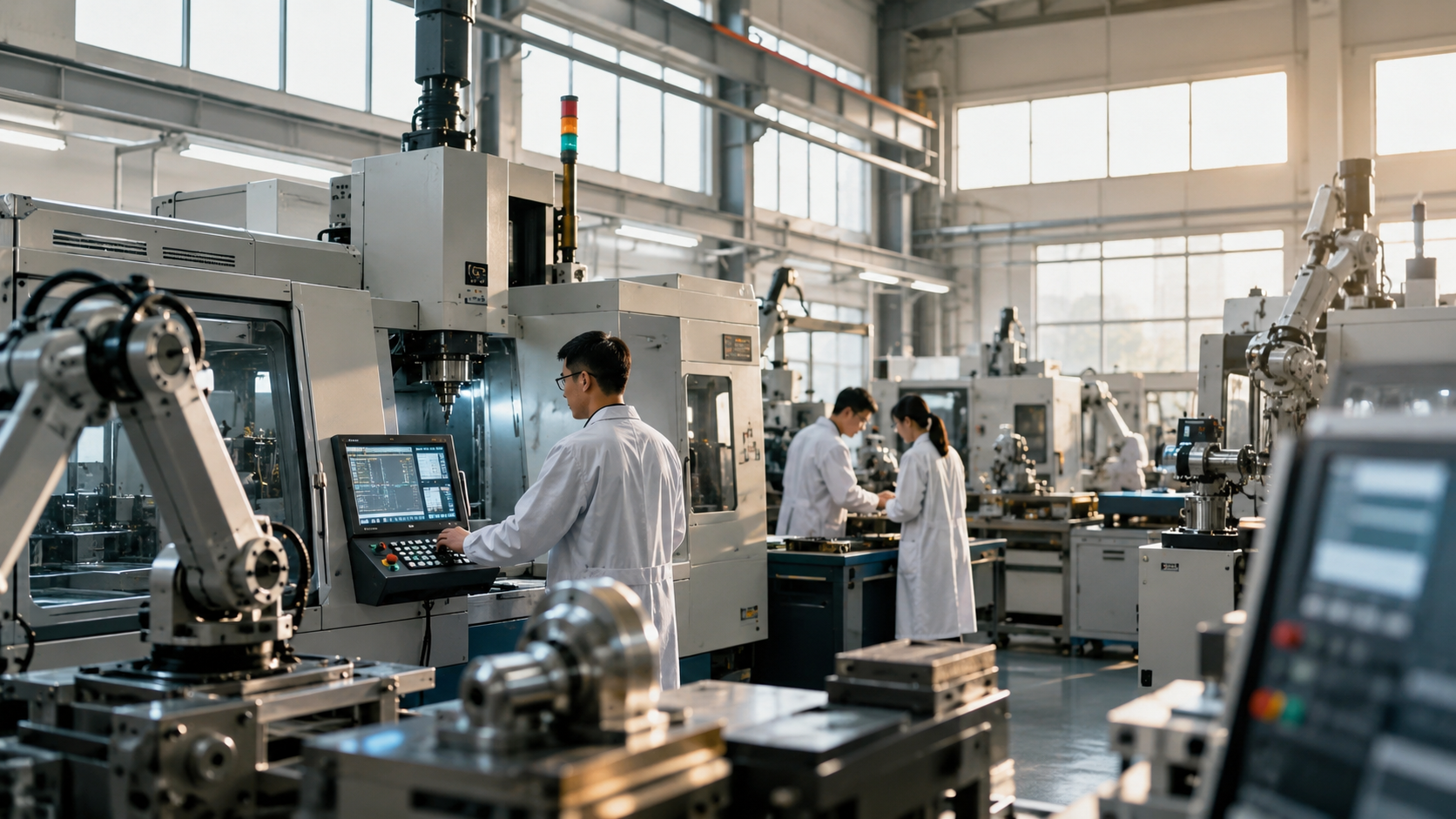
Engraving an Eggshell: Inside China's Precision Manufacturing - Authentic Chinese listening, reading, and speaking practice | Mandarin Ladder

蛋壳上的雕刻:中国三大创新中心如何破解科创“堵点”

Engraving an Eggshell: Inside China's Precision Manufacturing

Choose your learning path
Language & Culture

Cultural Context & Translation Notes

Explore Chinese expressions whose meaning depends on cultural, social, or policy context.

京津冀·Jīng-Jīn-Jì

Natural English: Beijing–Tianjin–Hebei (region)

A regional shorthand combining the conventional one-character abbreviations for Beijing (京), Tianjin (津), and Hebei (冀). It refers to the coordinated-development region grouping the capital, the neighboring municipality, and the surrounding province, and appears frequently in planning documents about industry and infrastructure across the three areas.

京雕的发展受益于京津冀协同发展。

Jingdiao's growth benefited from coordinated development across the Beijing–Tianjin–Hebei region.

卡脖子·kǎ bózi

Natural English: critical technology bottleneck (in some contexts, technology chokepoint)

Literally "to grip the neck." Used for a critical dependency or technological bottleneck that constrains further development, often — but not always — involving reliance on external suppliers for key components, materials, or tools. The phrase is common in industrial-policy discussion of areas where domestic capability is seen as insufficient.

高端数控机床曾被视为卡脖子领域。

High-end CNC machine tools were once seen as a bottleneck field.

疏解非首都功能·shūjiě fēi shǒudū gōngnéng

Natural English: redistributing non-capital functions from Beijing

A planning term for the orderly redistribution or relocation of selected industries, institutions, or public-service functions that are not considered necessary to concentrate in Beijing. It is associated with the Beijing–Tianjin–Hebei coordination policy. The phrase describes a direction of adjustment rather than a fixed list of targets.

疏解非首都功能是京津冀协同的重要内容。

Redistributing non-capital functions from Beijing is an important part of Beijing–Tianjin–Hebei coordination.

一小时通勤圈 / 一小时科创圈·yī xiǎoshí tōngqín quān / kēchuàng quān

Natural English: one-hour commuting circle / one-hour innovation zone

Planning expressions that use roughly one hour of travel time as a scale for describing regional connectivity and collaboration. "通勤圈" frames everyday movement of workers; "科创圈" frames the reach of research and industrial cooperation. "Circle" is a direct rendering of the Chinese planning term, though "zone" often reads more clearly in natural English.

京津冀正在构建一小时科创圈。

Beijing–Tianjin–Hebei is building a one-hour innovation zone.

自主研发·zìzhǔ yánfā

Natural English: independently developed (R&D led in-house)

Emphasizes that the main research and development capability is held by the company or domestic team itself. It does not necessarily mean that no foreign parts, tools, or collaborations are involved; the focus is on where the core design and know-how sit, not on complete exclusion of outside inputs.

这是一套完全自主研发的高精密数控机床。

This is a fully independently developed high-precision CNC machine tool.

This lesson is part of our Learn Chinese through Policy & Governance series.